 |
Science Frontiers
Sourcebook Project
Strange reports * Bizarre biology * Anomalous archaeology
From New Scientist, Nature, Scientific American, etc
Archaeology Astronomy Biology Geology Geophysics Mathematics Psychology Physics
|
|
Guides available

Omni Edge Science Winner
December 1996
| 
|
The Sourcebook Project
(Catalog of Anomalies)
Oct 2021
Sorry, all publications are now out of print
To acquire copies,
it is recommended that you visit addall.com
(and search for author = William Corliss)
The Sourcebooks, Handbooks and Catalogs are compiled from 40,000
articles from the scientific literature, the results of a 25-year
search through more than 12,000 volumes of scientific journals,
including the complete files of Nature, Science, Icarus, Weather,
etc. The Sourcebook Project
is compiling an objective, unsensationalized catalog of anomalous
phenomena. (See also: Subject Index | Science Frontiers On-line)
|
Scientific Anomaly Outlines
|
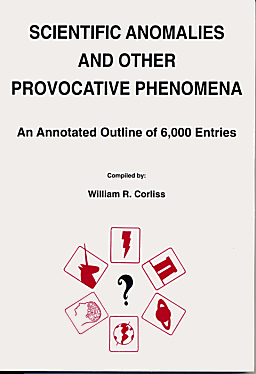
Scientific Anomalies and other Provocative Phenomena
Sorry, Out of print
An Annotated Outline of 6,000 Entries
It should not surprise anyone that this Outline contains about 6,000 entries, all of which remain unexplained to my satisfaction, or which, at the very least, I find curious and engaging. My main objectives with this volume are these:
- The compilation of a list of scientific phenomena worthy of further attention and research
- The presentation of a "first look" a the entire spectrum of what I have found anomalous, provocative, and exciting in science
- The provision, via a menu-type index, of a guide to my many already published Catalogs and Handbooks of anomalies and curiosities.
|
Major Paradigms Targeted
Anomalies exist only when they challenge paradigms and hypotheses. It is unavoidable, therefore, that some paradigms, widely considered to be fact, will be contradicted by many of the phenomena listed in this Outline. For example, the following paradigms that presently dominate scientific thinking are her considered to be at risk:
- The expanding universe
- The Big Bang origin of the universe
- Neo-Darwinism (specifically, evolution via random mutation and natural selection)
- That genomes are the complete blueprint for lifeforms
- Plate tectonics/continental drift
- Special and General Relativity
|
|
View Cart
| |
| |
Buy online via PayPal with MC/Visa/Amex
|
296 pages, softcover, $17.95, 244 illus., Jan 2003.
ISBN 0-915554-45-3, 7x10".
|
|
For a full list of biology subjects, see here.
Biological Anomalies: Humans I: A Catalog of Biological Anomalies
Sorry, Out of print
- This volume, the first of three on human biological anomalies,
looks at the "external" attributes of humans (1) Their
physical appearance; (2) Their anomalous behavior; and (3) Their
unusual talents and faculties.
- Typical subjects covered:
Mirror-image twins * The sacral spot * The supposed human aura
* Baldness among musicians * Human tails and horns * Human behavior
and solar activity * Cycles of religiousness * Cyclicity of violent
collective human behavior * Handedness and longevity * Wolf-children
* The "Mars Effect" * Telescopic vision *Dermo-optical
perception * Hearing under anesthesia * Human navigation sense
* Asymmetry in locomotion * Sex-ratio variations
- Comments From Reviews: "All I can
say to Corliss is carry on cataloging". New Scientist
|
View Cart
| |
| |
Buy online via PayPal with MC/Visa/Amex
|
304 pages, hardcover, $19.95, 52 illus., 3 indexes, 1992.
548 references, LC 91-68541. ISBN 0-915554-26-7, 7x10.
Biological Anomalies: Humans II: A Catalog of Biological Anomalies
Sorry, Out of print
- The second Catalog volume on human biological anomalies focuses
upon the "internal" machinery of the body (1) Its major
organs; (2) Its support structure (the skeleton); and (3) Its
vital subsystems (the central nervous system and the immune system)
- Typical subjects covered:
Enigma of the fetal graft * Phantom limbs * Blood chimeras * Anomalous
human combustion * Bone shedders * Skin shedders * "Perfection"
of the eye * Dearth of memory traces * Sudden increase of hominid
brain size * Health and the weather * Periodicity of epidemics
* Extreme longevity * AIDS anomalies * Cancer anomalies * Human
limb regeneration * Nostril cycling * Voluntary suspended animation
* Male menstruation [Picture caption: Is the complexity of the
human eye anomalous?]
297 pages, hardcover, $19.95, 40 illus., 3 indexes, 1993.
494 references, LC 91-68541, ISBN 0-915554-27-5, 7x10.
Biological Anomalies: Humans III: A Catalog of Biological Anomalies
Sorry, Out of print
- Completing our trilogy on human anomalies, this volume focuses
on four areas (1) the human fossil record; (2) biochemistry and
genetics; (3) possible unrecognized living hominids; and (4) human
interactions with other species and "entities "
- Typical subjects covered:
Neanderthal demise * Giant skeletons * Tiny skeletons * Hominid
gracilization * Sudden brain expansion * Human chimeras * Sasquatch
/ Bigfoot, Alma, Yeti, and others * Human-animal communication
* Humanity and Gaia * Anomalous distribution of human lice
- Comments from reviews: "Some fascinating
thinking om the frontiers of science", Borderlands.
212 pages, hardcover, $19.95, 44 illus., 3 indexes, 1994.
311 references, LC 91-68541. ISBN 0-915554-29-1, 7x10.
For a full list of biology subjects, see here.
Biological Anomalies: Mammals I: A Catalog of Biological Anomalies
Sorry, Out of print
- The first three biology catalogs deal with human anomalies.
Here, we attend to the "other" mammals, and two volumes
will be required This, the first, parallels Humans I in
focusing on external attributes (1) physical appearance; (2) behavior;
and (3) talents and faculties.
- Typical subjects covered:
Mammal-marsupial parallelisms * Zebra stripe reversal * Marching
teeth * Lunar effect on activity * Mammalian art and music * Rat
and squirrel "kings" * Cetacean mass strandings * Mummified
Antarctic seals * Navigation and homing * Soaring and parachuting
* Mammalian engineering works * Deep-diving capabilities * Unusual
vocalisations * Intelligence overshoot. [Picture caption: A yapok.
A South American aquatic marsupial. The female possesses a watertight
pouch. Strangely, the male also has a pouch !]
|
View Cart
| |
| |
Buy online via PayPal with MC/Visa/Amex
|
292 pages, hardcover, $21.95, 84 illus., 3 indexes, 1995.
546 references, LC 91-68541. ISBN 0-915554-30-5, 7x10.
Biological Anomalies: Mammals II: A Catalog of Biological Anomalies
Sorry, Out of print
- Our fifth biology catalog completes out study of mammilian anomalies. This volume parallels Humans II and III with major sections on the fossil record and cryptozoology. In addition, there are shorter sections on genetics, organs, bodily functions, and interactions between mammals and other life forms.
- Typical subjects covered:
Biochemical curiosities * Recent survivals of the mammoth, ground sloth, thylacine * Out-of-place mammals * Dearth of transistional fossils * Male lactation * Sleeplessness in mammals * Inheritance of rotational effects * Magnetite in mammals * Microbat data processing * The onza, nandi bear, Steller's sea ape, and others.
- Comments from reviews: Essential for all libraries, schools and serious Forteans. Fortean Times
|
View Cart
| |
| |
Buy online via PayPal with MC/Visa/Amex
|
324pp, hardcover, $21.95, 89 illus., 3 indexes, 1996.
527 references, LC 91-68541. ISBN 0-915554-31-3. 7" x 10".
Biological Anomalies: Birds: A Catalog of Enigmas and Curiosities
Sorry, Out of print
- Birds are everywhere: some can fly high over the Himalayas, others can dive as deep as 500 meters in the oceans, some migrate unerringly from one end of the earth to the other. With more than 9,000 species recongnized, birds present us with hundreds of scientific puzzle to solve.
- Typical subjects covered:
Asymmetric birds * Wing claw and spurs * Inherited callosities * Unrelated birds that look alike * Enigmas of avian instincts * The intelligence of birds * An avian aesthetic sense? * Birds that roost upside down * The insiduous nature of brood parasitism * Avian battles, courts, funerals * Unsolved mysteries of migration * Poisonous birds * The unique avian respiratory system * The two-voice pheonomenon * Echolocation in birds
|
View Cart
| |
| |
Buy online via PayPal with MC/Visa/Amex
|
486 pages, hardcover, $27.50, 150 illus., 3 index, 1998.
1170 references, LC 91-68541. ISBN 0-915554-32-1, 7" x 10"
Incredible Life: A Handbook of Biological Mysteries
Out of print
- Hardcover, 1018 pages, March 1981, ISBN: 0-915554-07-0, 9.5 x 6.5 x 0.2 inches
Unfathomed Mind: A Handbook of Unusual Mental Phenomena
Out of print
- Hardcover, 754 pages, Apr 1982, ISBN: 0-915554-08-9, 9.5 x 6.5 inches
For a full list of archeology subjects, see here.
Ancient Man: A Handbook of Puzzling Artifacts
Sorry: Out of Print. No longer available.
- Now in its third printiing, our archeology Handbook reproduces
hundreds of items from the difficult-to-obtain archeological literature.
- Typical subjects covered:
Ancient Florida canals * The Maltese "cart tracks"
* New England earthworks * Ancient coins in America * Ancient
Greek analog computer * Inscriptions and tablets in unexpected
places * The great ruins at Tiahuanaco * Zimbabwe and Dhlo-dhlo
* Huge spheres in Costa Rica * The Great Wall of Peru * Ancient
batteries and lenses * Mysterious walls everywhere * Pacific megalithicsites * European stone circles and forts * [Picture caption: Scottish
carved stones from circa 1000 B.C.
- Comments from reviews "...a useful
reference in undergraduate, public, and high school libraries",
Booklist.
- 792 pages, hardcover, $23.95, 240 illustrations, index. 1978
references. LC 77-99243, ISBN 915554-03-8, 6x9forrnat.
Ancient Infrastructure: Remarkable Roads, Mines, Walls, Mounds, Stone Circles
Sorry, Out of print
Ancient people raised standing stones on all continents save Antarctica. The dug canals 50 miles long and erected even longer walls. Gleaned from hundreds of volumes of Science, Nature, Antiquity and other science journals, this massive collection of archeological puzzles will keep researchers digging for decades.
- Costa Rica's enigmatic stones spheres
- Peru's Intervalley Canal
- Iraq's 100,000 miles of subterranean tunnels (the qanats)
- Nova Scotia's "Money Pit"
- Egypt's canal to the Red Sea
- North America's Calendar sites
- Medicine Wheels and woodhenges
- Sculpted hills and mountains
|
- Chaco Canyon's curious roads
- The puzzling East Bay walls
- Lake Superior's copper mines
- Stone arrays and meanders
- Florida's shell keys
- Poverty Point and Watson Brake
- Malta's strange "cart ruts"
|
|
View Cart
| |
| |
Buy online via PayPal with MC/Visa/Amex
|
412 pages, softcover, $21.95. 255 illustrations, 3 indexes, 2006.
855 references. LC 99-94987, ISBN 0-915554-49-6, 7 x 10"
Hardcover edition, 1999, ISBN 0-915554-33-X: Out of print
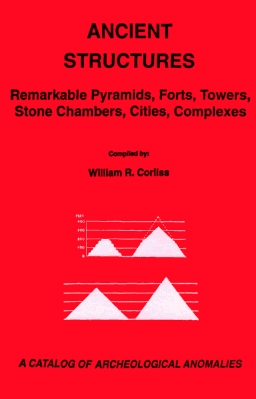
Ancient Structures: Remarkable Pyramids, Forts, Towers, Stone Chambers, Cities, Complexes
Sorry: Out of Print. No longer available.
- Ancient astronomical observatories
- Vitrified forts
- Ancient furnaces, smelteres and hearths
- The Newport Tower
- New Grange and other passage graves
- Enigmas of the Great Pyramid
- Nan Madol and Mohenjo-daro
- New England stone chambers
- Mystery Hill; America's Stonehenge
- Anonymous stone chambers and passage graves
- Cities and complexes
- Inca stonework
337 pages, hardcover, $24.95 193 illus., 3 indexes, 2001
528 references, LC 00-092706 ISBN 0-915554-35-6, 7 x 10
|
|
|
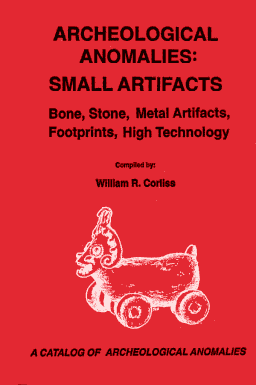
Archeological Anomalies: Small Artifacts
Sorry: Out of Print. No longer available.
- Bone artifacts: Anomalous early bone tools; Bone artifacts of uncertain affiliation; Pre-Clovis bone tools in the New World; Anomalous association of animal bones with ancient human presence; Artificially worked animal bones of great age; Grooved, punctured, Pounded human bones; Evidence of ancient skull surgery (trepanation); Scratched and smashed bones: The cannibalism signature; Exotic mummies
- Cloth artifacts: Viking cloth in the High North American Arctic; Diffusion of dyed, patterned textile technology; The early selective breeding of colored cotton in the New World; Stone-Age clothing surprisingly modern; Llama wool indicates selective breeding; Similarity of Chinese and Aztec plumagery; Woven cloth in North American mounds; A woven mat encased in salt; The uncertain origin of the image on the Shroud of Turin.
- Geological artifacts: Megamiddens -- Giant Bronze-Age waste deposits; Fossil food; Unexplained ground disturbances; Apparent metal tool marks on coalified or petrified wood; Fossilized human-like footprints in ancient rocks; Ancient human handprints; Anomalous Hominid-built hearths and fire areas;
- Metal artifacts: Low-tech metal artifacts; Familiar metal artifacts claimed to have been found embedded in geologically old rocks; Heavily mineralized, familiar metal artifacts not embedded in bedrook; Enigmatic, artificial-appearing metallic objects found in ancient rocks.
- Pottery artifacts: Pottery that is anomalous in geographical location and/or age; Enigmatic ceramic artifacts.
- Stone artifacts: Stone artifacts with anomalous ages; Large assemblages or caches of stone implements; Stone artifacts found in unexpected locations; Pigmy flints and other microliths; Nonutilitarian and totally enigmatic stone artifacts.
- High-Technology artifacts: Ancient chemistry; Ancient metallurgy; ancient surgery and dentistry; Micro-work -- The magnificent conundrum; Artifacts fashioned from very hard materials -- the tool conundrum; Ancient music instruments; Potentially anomalous toys and models; Ancient scientific instruments; Claims of ancient knowledge of electricity; Ancient calculating devices; Speculation about ancient flying machines.
- Wooden artifacts: Wooden artifacts in unexpected places; Advanced wooden weapons; Remarkable ancient wooden tools; Wooden artifacts suggesting unexpected cultural diffusion; Wooden artifacts of apparent great age.
319 pages, $24.95 hardcover, 3 indexes, 2003
ISBN 0-915554-46-1, 7 x 10-in
|
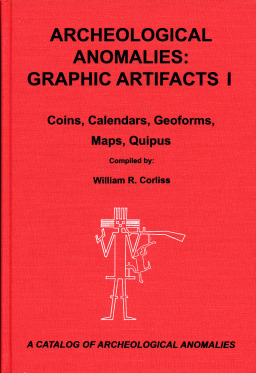
Archaeological Anomalies: Graphic Artifacts I
Sorry: Out of Print. No longer available.
- Anomalous coins: Coins of Precolumbian mintage found in the New World; Ancient Egyptian coins found in Australia; Deeply buried ancient coins; Oxhide currency in the Precolumbian New World; Coins with maps.
- Geoforms: Terrestrial Graphics: The Nazca Lines; Cuzco: the mirror of the cosmos; Notable intaglio morphs everywhere; Emblematic and effigy mounds; Large boulders and gravel effigies; Population-center patterns; Large-scale terrestrial sculptures
- Zodiacs and Calendars: Zodiac anomalies and curiosities; Unusual bone calendars; Ancient stone calendars and time markers; Curious but scarcely anomalous wooden calendars; Textile calendars; "Quipu" calendars; A porported Olmec calendar mozaic; A golden calendar lozenge; Calendars of non-Astronomical events; Is the Mallia table a calendar?; Ancient mechanical calendars; The Mesoamerican 260-day calendar; Transpacific calendar affinities; Other selected structures and artifacts with calendar characteristics
- Anomalous Maps: The Vinland map; Old maps that reveal an ice-free Antarctica; The Waldseemuller map and a possible Chinese connection; Ancient Chinese world maps; Micronesian stick charts; Maps of selected phantom islands; Map anomalies on ancient coins; "Oldest" maps; The Mysterious origin of the Portolans;
- Quipus and Related Information Carries: Literary quipus; Sticks, bones, and stones as information carries
182 pages, $21.95, hardcover, 3 indexes, 2006
ISBN 0-915554-48-8, 7 x 10-in
|
|
For a full list of geophysics subjects, see here.
|
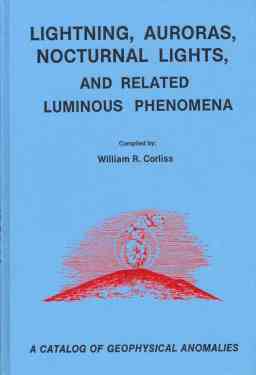
Lightning, Auroras, Nocturnal Lights: A Catalog of Geophysical Anomalies
Sorry: Out of Print. No longer available.
- Nothing catches the human eye and imagination as quickly as
a mysterious light. All down recorded history, scientists and
laymen alike have been seeing strange lightning, sky flashes,
and unaccountable luminous objects.
- Typical subjects covered:
Horizon-to-horizon sky flashes * Episodes of luminous mists *
Mountain-top glows (Andes glow) * Earthquake lights * Ball lightning
with tails * Rocket lighting * Lightning from a clear sky * Ghost
lights; ignis fatuus * Darting streaks of light (sleeks) * The
milky sea and light wheels * Radar-stimulated phosphorescence
of the sea * Double ball lightning * Luminous phenomena in tornados
* Black auroras * [Picture caption: Luminous display over Mt.
Noroshi during earthquake swarm]
- Comments from reviews "...the book
is well-written and in places quite fascinating", Science
Books.
- Contents also included in Remarkable Luminous Phenomena in Nature
248 pages, photocopied edition, $16.95, 74 illustrations, 5 indexes,
1982. 1070 references, LC 82-99902, ISBN 915554-09-7, 7x10-in format.
Hardcover edition, $24.95: out of stock
|
Tornados, Dark days, Anomalous Precipitation: A catalog of Geophysical Anomalies
Sorry: Out of Print. No longer available.
- Here is our "weather' Catalog. As everyone knows, our
atmosphere is full of tricks, chunks of ice fall from the sky,
tornado funnels glow at night. The TV weathermen rarely mention
these "idiosyncrasies". [Picture caption: Conical hailstones
with fluted sides]
- Typical subjects covered:
Polar-aligned cloud rows * Ice fogs (the Pogonip) * Conical hail
* Gelatinous meteors * Point rainfall * Unusual incendiary phenomena
* Solar activity and thunderstorms * Tornados and their association
with electricity * Multiwalled waterspouts * Explosive onset of
whirlwinds * Dry fogs and dust fogs * Effect of the moon on rainfall
* Ozone in hurricanes * Ice falls (hydrometeors)
- Comments from reviews: "...can be
recommended to every one who realizes that not everything in science
has been properly explained", Weather
- 202 pages, hardcover, $16.95, 40 Illustrations, 5 indexes,
1983. 745 references, LC 82-63156, ISBN 915554-10-0, 7x10 format.
Earthquakes, Tides, Unidentified Sounds: A Catalog of Geophysical
Anomalies
Sorry: Out of Print. No longer available.
- Quakes and monster, solitary waves and natural detonations;
these are the consequences of solids, liquids, and gases in motion.
In our modern technological cocoon, we are hardly aware of this
rich spectrum of natural phenomena. [Picture caption: Sand craters
created by earthquakes]
- Typical subjects covered:
Periodic wells and blowing caves * Sun-dominated tides * Immense,
solitary waves * Animal activity prior to earthquakes * Earthquake
geographic anomalies * Earthquake electricity * The sound of the
aurora * Musical sounds in nature * Mysterious detonations * Anomalous
echos * Slicks and calms on water surfaces * Periodicities of
earthquakes * The vibrations of waterfalls * Unusual barometric
disturbances
- Comments from reviews: "...surprisingly
interesting reading", Nature
220 pages, photocopied edition, $16.95p, 32 illustrations, 5 indexes, 1983.
790 references, LC 83-50781, ISBN 915554-11-9, 7x10 format
Rare Halos, Mirages, Anomalous Rainbows: A Catalog of Geophysical Anomalies
Sorry: Out of Print. No longer available.
- Most of us have seen rings around the moon, but what does
it mean when such rings are not circular or are off-center? Neither
are rainbows and mirages devoid of mysteries. And the Brocken
Specter still startles Alpine climbers!
- Typical subjects covered:
Rainbows with offset white arcs * Sandbows * Offset and skewed
halos * The Brocken Specter * The Alpine Glow * Unexplained features
of the green flash at sunset *Fata Morgana * Telescopic mirages
* Long-delayed radio echos * Eclipse shadow bands * Geomagnetic
effects of meteors * Intersecting rainbows * The Krakatoa sunsets
* Kaleidoscopic suns [Picture caption: Shadow of Adam's Peak with
glory and radial rays]
- Comments from reviews: "...all in
all it's a fascinating book", Sky And Telescope. "...any
student of the physical sciences will find it fascinating",
Science Books.
244 pages, hardcover, $16.95, 111 illustrations, 5 indexes
1984. 569 references, LC 84-50491, ISBN 915554-12-7, 7x10 format.
Remarkable Luminous Phenomena in Nature: A Catalog of Geophysical Anomalies
Sorry: Out of Print. No longer available.
-
This volume is a major expansion of the first catalog in this series, Lightning, Auroras, Nocturnal Lights, first published in 1982. So much additional information on luminous phenomena has been collected, that this new edition is almost twice the size of the 1982, that a new title seems appropriate.
- Dozens of new phenomena are recognized, and we have added a great many eye-witness account (mostly from science journals) of low-level auroras, ball lightning, earthquake lights, marine wheels, luminous phenomena above thunderclouds, and, especially, lengthy coverages of low-level nocturnal lights (Marfa, Brown Moutnain, Min Min, Nekha, Hessdalen, etc).
- Topic covered include:
- Aurora-like phenomena
- Ball Lightning
- Diffuse Electrical Discharge Phenomena
- Lightning Anomalies
- Low-Level Meteor-Like Luminous Phenomena
- Nocturnal Lights
- Marine Phosphorescent Displays
425 pages, hardcover, $24.95, 128 illustrations, Time-of-event index, Source index, First-author index, Subject index, 1660 references. 2001. LC 2001126955, ISBN 0-915554-44-5. 7 x 10" format
|

|
|
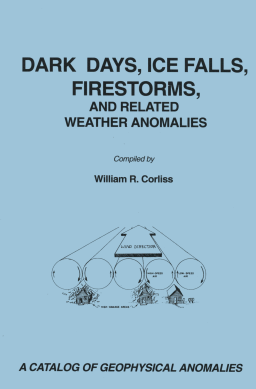
Dark Days, Ice falls, Firestorms and Related Weather Anomalies
Sorry: Out of Print. No longer available.
- "Weather" is a composite experience of sight, sound, temperature, and other sensations of the elements. The phenomena of this Catalog volume are not primarily luminous or acoustic or confined to the sensory channels that form the bases for the other volumes in the field of geophysics. Here, we deal with rain, fog, wind, clouds, precipitation, and sunshine-- but only when they are anomalous or at least curious enough to attract our attention.
- Several themes that thread their ways through the geophysical volumes of the Catalog recur in this book:
- The importance of electricity in geophysical phenomena
- The possible influences of the sun, moon, planets, and inbound meteoric material on terrestrial weather
- The occasional prankish, frivolous behavior of some weather phenomena. This judgment is, of course, highly subjective.
- One interesting feature of weather phenomena taken as a whole is their rather low level of anomalousness; at least when compared to other geophysical phenomena in the Catalog of Anomalies. Weather, it seems, is not as strange as, say, luminous geophysical phenomena. There are more plausible theories available to explain weather phenomena than for ball lightning or long-delayed radio echoes. Of course, this does not mean that science understands all facets of the weather---this volume would not exist if it did.
327 pages, softcover, $24.95, illustrations, Time-of-event index, Source index, First-author index, Subject index, references. 2006. ISBN 0-915554-62-3. 7 x 10" format
|
For a full list of geology subjects, see here.
|
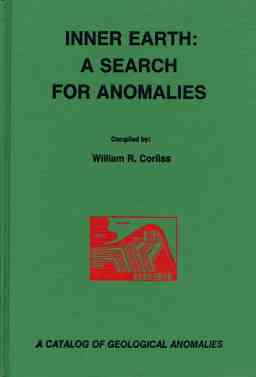
Inner Earth: A Search for Anomalies; A Catalog of Geological Anomalies
Sorry, Out of print
- The focus of this, the eleventh volume in the Catalog of Anomalies,
is the earth's interior, which is revealed to us mainly through
seismic signals, magnetic variations, and the flow of heat from
great depths. Hundreds of kilometers below the surface lurk huge
pieces of foundered continental crust and bizarre structures of
unknown origin.
- Typical subjects covered:
Anomalous gravity signals * Mid-plate volcanism * Mysterious
seismic reflectors * Seismic velocity discontinuities * Deep-focus
earthquakes * Incompleteness of the stratgraphic record * Cyclothems
and rhythmites * Exotic terranes * Compass anomalies * Earth-current
anomalies * Problems of paleomagnetism * Polarity reversals [Picture
caption: Model of the earth's interior]
|
View Cart
| |
| |
Buy online via PayPal with MC/Visa/Amex
|
230 pages, hardcover, $18.95, 52 illustrations, 5 indexes
1991, references, LC 90-92347, ISBN 915554-25-9, 7x10 format.
|
Carolina Bays, Mima Mounds, Submarine Canyons; A Catalog of Geological Anomalies
Sorry, Out of print
- Topographical phenomena are the subject of this Catalog. The
ups and downs of the earth's surface betray many anomalies. Could
continental drift be inferior to the expanding earth hypothesis?
Have ocean levels fluctuated wildly down the eons?
- Typical subjects covered:
Carolina Bays and oriented lakes * Large circular structures
* Immense craters * Raised beaches * Guyots (flat-topped seamounts)
* Island arcs * Doubts about plate tectonics (continental drift)
* Mima mounds * Drumlin anomalies * Patterned ground * Esker problems
* Lake walls and ramparts * Crevicular structure * Submarine canyons
[Picture caption: Pyramid of frozen foam on the Bozenkill, New
York State]
- Comments from reviews: "...enough
terrestrial intrigue to keep us thinking for years",
Pursuit.
|
View Cart
| |
| |
Buy online via PayPal with MC/Visa/Amex
|
245 pages, hardcover, $17.95, 84 illustrations, 5 indexes
1988, 682 references, LC 87-63408, ISBN 915554-22-4, 7x10 format.
|
|
|
Anomalies in Geology: Physical, Chemical, Biological; A Catalog of Geological Anomalies
Sorry: Out of Print. No longer available.
- Journey here into ice caves, exhume Siberian mammoths, see
animals perish in gas-filled valleys -- a little media hype is
justified here. But more serious questions involve the origins
of oil, coal, and natural gas.
- Typical subjects covered:
Biological extinction events * Musical sands, ringing rocks *
Anomalies of oil's origin * Ice caves, frozen wells * Natural
fission reactors * Marine organisms and fossils found far inland
* Siberia's frozen mammoths * Radiometric dating problems * Anchor
ice, frazil ice * Violent lake turnovers * Flexible rocks * Origin
of ocean water * Skipping in fossil record * Valleys of death
* Prismatic sandstone from Missouri
335 pages, hardcover, $18.95, 55 illustrations, 5 indexes
1989. 1260 references, LC 89-90680, ISBN 915554-23-2, 7x10 format.
|
Neglected Geological Anomalies: A Catalog of Geological Anomalies
Sorry: Out of Print. No longer available.
- Neglected but far from insignificant are the anomalies cataloged
here. Do we really know how concretions and geodes form, where
tektites come from, whence the immense deposits of superficial
debris all over our globe ? [Picture caption: Mace-shaped and
sand-spike concretions from the Colorado delta]
- Typical subjects covered:
Concretions and geodes * Tektites and microtektites * Erratic
boulders and gravels * Polystrate fossils * Bone caves and bone
beds * Giant basalt flows * Natural glasses * Surging glaciers
* Driftless regions * Stretched pebbles * Crystal inclusions *
Rarity of fossil meteorites and tektites * Elevated erratics *
Stone rivers and rock glaciers
333 pages, hardcover, $18.95, 80 illustrations, 5 indexes
1990. 1030 references, LC 90-60568, ISBN 915554-24-0, 7x10 format.
|
|
Unknown Earth: A Handbook of Geological Enigmas
Out of print
- Hardcover, 833 pages, January 1980, ISBN: 0-915554-06-2
For a full list of astronomy subjects, see here.
|
The Moon and the Planets; A Catalog of Astronomical Anomalies
Sorry: Out of Print. No longer available.
- From our own moon's cratered surface to the red, rock-strewn
plains of Mars, the Solar System is a fertile field for scientific
research. Despite centuries of observation, each new spacecraft
and telescope provides us with new crops of anomalies [Picture
caption: One drawing of the Venusian radial spoke system]
- Typical subjects covered:
The ashen light of Venus * The Martian 'pyramids' * Kinks
in Saturn's rings * Continuing debate about the Voyager life-detection
experiments * Neptune's mysterious ring * Evidence of water on
Mars * The grooves on Phobos * The two faces of Mars * Lunar clouds,
mists, "weather" * Ring of light around the new moon
* Dark transits of Jovian satellites * Io's energetic volcanos
* Jupiter as a "failed star" * Venus-earth resonance
- Comments from reviews: "The author
is to be commended for his brilliantly conceived and researched
volume", Science Books.
383 pages, hardcover, $18.95, 80 illustrations, 4 indexes
1985. 988 references, LC 85-61380, ISBN 915554-19-4, 7x10 format.
|
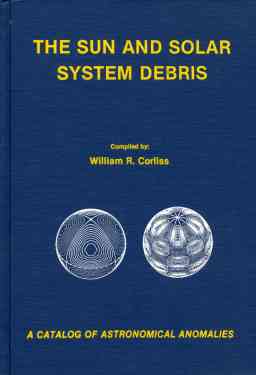
The Sun and Solar System Debris: A Catalog of Astronomical Anomalies
Sorry: Out of Print. No longer available.
- Our sun, powerhouse of the Solar System and an enigma itself,
is orbited by clouds of asteroids, comets, meteors and space dust
These "minor objects" cause "major headaches"
to astronomers searching for explanations.
- Typical subjects covered:
Solar svstem resonances * Bode's Law and other regularities
* Blackness of comet nuclei * Cometary activity far from solar
influences * Unidentified objects crossing sun * The 'missing'
solar neutrinos * Pendulum phenomena during solar eclipses * Observations
of Planet X * Meteorite geographical anomalies * Meteorites from
the moon * Long fireball processions * Very long duration meteorites
* Zodiacal light brightness changes * [Picture caption: One of
the many possible modes of solar surface oscillation]
- Comments from reviews: "It is an
unusual book, nicely executed, and I recommend it highly",
Icarus.
288 pages, hardcover, $17.95, 66 illustrations,4 indexes
1986. 874 references, LC 86-60231, ISBN 915554-20-8, 7x10 format.
|
|
|
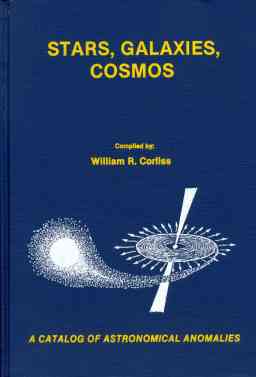
Stars, Galaxies, Cosmos: A Catalog of Astronomical Anomalies
Sorry: Out of Print. No longer available.
- Did the Big Bang really begin the existence of all we know?
Do we honestly know how the stars (and our sun) work? Can we rely
on Newton's Law of Gravitation? According to this volume the answer
seems to be "Probably not ! "
- Typical subjects covered:
Optical bursters and flare stars * Estorical color change
of Sirius * Infrared cirrus clouds * Quasar-galaxy associations
* The red-shift controversy * Quantization of red shifts * The
quasar energy paradox * Apparent faster-than-light velocities
in quasars and galaxies * Evidence for universal rotation * Swiss
cheese structure of universe * Is the "missing mass"
really missing ? * Superluminous infrared galaxies * Shells around
elliptical galaxies
- Comments from reviews: "...it never
fails to be interesting, challenging and stimulating",
New Scientist
246 pages, hardcover, $17.95, 50 illustrations, 4 indexes
1987. 817 references, LC 87-60007, ISBN 915554-21-6, 7x10 format.
|
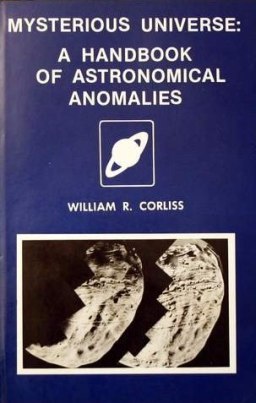
Mysterious Universe: A Handbook of Astronomical Anomalies
Sorry, Out of print
- Our Astronomy Handbook covers much the same ground as the
three preceding Astronomy Catalogs, but in more detail. For example,
the quotations are much more extensive [Picture caption: Unexplained
rift in the zodiacal light]
- Typical subjects covered:
The lost satellite of Venus * Transient lunar phenomena * Ephemeral
earth satellites * Venus' radial spoke system * Relativlty contradicted
* Cosmological paradoxes * Changes in light's velocity * Vulcan;
the intramercurial planet * Knots on Saturn's rings * Bright objects
near the sun * The Sun's problematical "companion star"
* "Sedimentary" meteorites * Life chemistry in outer
space * Planet positions and sunspots
- Comments from reviews: "...highly
recommended ... excellent value for money", Nature (Astronomy
Book Club selection)
|
View Cart
| |
| |
Buy online via PayPal with MC/Visa/Amex
|
716 pages, hardcover, $19.95, 103 illustrations, index, 1979
References, LC 78-65616, ISBN 915554-05-4, 6x9 format.
A Handbook of Unusual Natural Phenomena
Out of print
- Luminous Phenomena * Optical and Radio Anomalies in the Atmosphere * Unusual Weather Phenomena * Mysterious Natural Sounds * The Strange Phenomena of Earthquakes * Phenomena of the Hydrosphere * Falling Material * Magnetic Disturbances
- 542 pages, hardcover, 600 articles, 130 illustrations, index, Feb. 1973, LC. 76-49382. ISBN: 0-915554-01-01
|
Science Frontiers: The Books
|
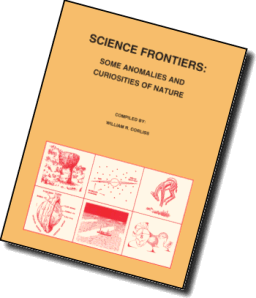
Science Frontiers: Some Anomalies and Curiosities of Nature
Sorry, Out of print.
An indexed compilation of the first 86 issues of our newsletter Science Frontiers ( details).
- Chapter 1. Archeology: Ancient Engineering
Works * Small Artifacts * Epigraphy and Art * Bones and Footprints
* Diffusion and Culture.
- Chapter 2. Astronomy: Planets and Moons *
Solar System Debris * Stars * Galaxies and Quasars * Cosmology.
- Chapter 3. Biology: Humans .* Other Mammals
* Birds * Reptiles and Amphibians * Fish * Arthropods * Invertebrates
* Plants and Fungi * Microorganisms * Genetics * Origin of Life
* Evolution.
- Chapter 4. Geology: Topography * Geological
Anomalies * Stratigraphy * Inner Earth.
- Chapter 5. Geophysics: Luminous Phenomena*
Weather Phenomena * Hydrological Phenomena * Earthquakes * Anomalous
Sounds * Atmospheric Optics.
- Chapter 6. Psychology: Dissociation Phenomena
* Hallucinations * Mind - Body Phenomena * Hidden Knowledge *
Reincarnation * Information Processing * Psychokinesis.
- Chapter 7. Chemistry, Physics, Math, Esoterica:
Chemistry * Physics * Mathematics.
- Comments from reviews: "This fun-to-read
book may lead some to new scientific solutions through questioning
the phenomena presented", Science Books and Films
356 pages, paperback, $18.95, 417 illus., subject index, 1994.
1500+ references, LC 93-92800 ISBN 0-915554-28-3, 8.5 x 11
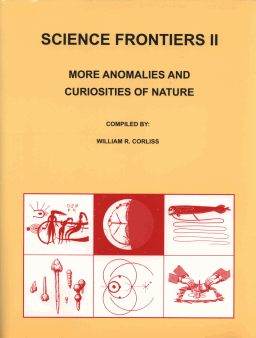
Science Frontiers II: More Anomalies and Curiosities Of Nature
Sorry, Out of print
An indexed compilation of the first 86 issues of our newsletter Science Frontiers (details).
- Chapter 1. Archeology:
* Ancient Engineering Works
* Small Artifacts
* Epigraphy and Art
* Diffusion and Culture
- Chapter 2. Astronomy:
* Planets and Moons
* Solar System Debris
* Stars
* Cosmology
- Chapter 3. Biology:
* Humans
* Other Mammals
* Birds
* Reptiles
* Amphibians
* Fish
* Arthropods
* Invertebrates
* Plants and Fungi
* Microorganisms
* Superorganisms
* Genetics
* Origin of Life
* Evolution
- Chapter 4. Geology:
* Topography
* Stratigraphy
* Inner Earth
* Geological Miscellany
- Chapter 5. Geophysics:
* Luminous Phenomena
* Weather Phenomena
* Hydrological Phenomena
* Exotic Seismic Signals
* Anomalous Sounds
* Atmospheric Optics
- Chapter 6. Psychology:
* Dissociation Phenomena
* Hallucinations
* Mind-Body Phenomena
* Hidden Knowledge
* Information Processing
* Psychokinesis
- Chapter 7. Chemistry, Physics, Math, Esoterica:
* Chemistry
* Physics
* Mathematics
* Esoterica
338 pages, paperback, $21.95, ISBN 0-91555-47-X
8.5 x 11
The first publications of the Sourcebook Project appeared in the
early 1970s. These were loose-leaf notebooks called "Sourcebooks."
Here were reproduced articles and excerpts of articles dealing
with anomalous phenomena. Although these Sourcebooks were superseded
by the Handbooks and Catalogs, the continuing demand for them
has encouraged us to keep most of them in print, as detailed below:
|
View Cart
| |
Buy online via PayPal with MC/Visa/Amex
|
- Strange Universe: A Sourcebook of Curious Astronomical Observations (Astronomical Anomalies) Out of Print
- Vol. A1, 285 pp., 1975, $16.95, Xeroxed text, plain binder. ISBN: 0-9600712-7-X
- Vol. A2, 286 pp , 1977, $16.95 Xeroxed text, plain binder. ISBN: 0-915554-02-X
- Strange Planet: A Sourcebook of Unusual Geological Facts (Geological Anomalies) Out of Print
- Vol. E1, 289 pp , 1975, $16.95 Printed text and binder. ISBN: 0-9600712-3-7
- Vol. E2, 275 pp , 1978, $16.95 Xeroxed text, plain binder. ISBN: 0-915554-04-6
- Strange Phenomena: A Sourcebook on Unusual Natural Phenomena (Geophysical Anomalies) Out of Print
- Vol. G1, 277 pp , 1974, $16.95 Xeroxed text, plain binder. ISBN: 0-9600712-1-0
- Vol. G2, 270 pp , 1974, $16.95 Printed text, plain binder. ISBN: 0-9600712-5-3
- Strange Artifacts: A Sourcebook on Ancient Man (Archeological Anomalies) Out of Print
| - Vol. M1, 268 pp , 1974, $16.95 Xeroxed text, plain binder. ISBN: 0-9600712-2-9
|
| - Vol. M2, 293 pp , 1976, $16.95 Xeroxed text, plain binder. ISBN: 0-9600712-6-1
|
- Strange Minds: A Sourcebook of Unusual Mental Phenomena (Psychological Anomalies) Out of Print
- Vol. P1, 291 pp. 1976, $16.95 Printed text, plain binder. ISBN: 0-915554-00-3
- Strange Life: A Sourcebook on the Mysteries of Organic Nature (Biological Anomalies) Out of Print
- Vol. B1, 1976, $16.95 Printed text, plain binder. ISBN: 0-9600712-8-8
|
Uses for the catalogs and handbooks
|
(l) Librarians will find these books to be unique collections
of source materials and bibliographies; (2) Scientists will find
research ideas as well as unexpected observations and many references;
(3) Students can use these books to select and develop research
papers and theses; (4) The science-oriented layman will find thousands
of those mysteries of nature that make science exciting.
The Catalog of Anomalies is in effect an encyclopedia of the unknown
and puzzling that is based primarily upon recognized scientific
research. It is the only organized, indexed, unsensationalized
collection of difficult-to-explain phenomena. The Catalog is supplemented
by several "Handbooks" containing more voluminous descriptions
of some of the phenomena.
Reviews in scientific and library publications
The Catalogs and Handbooks have been favorably reviewed in many
scientific journals, such as Nature, American Scientist, and New
Scientist. In addition, library publications such as Choice, Booklist,
and Science Books have recommended them. Four have been book club
selections. All Catalogs and Handbooks have been compiled by William
R. Corliss
Sorry, all publications are now out of print
and the publishers have closed.
Ordering information
Prices are in U.S. dollars. Canadian dollars and pounds sterling
are accepted at prevailing exchange rates. U.S. customers should
add $2.00 for each order under $30.
International orders: Shipping for foreign customers will be at the prevailing cost of U.S. Postal Service international priority mail. Unfortunately we ship only to customers only in: Australia,
Austria,
Bahamas,
Belgium,
Bermuda,
Canada,
Denmark,
Finland,
France,
Germany,
Greece,
Ireland,
Italy,
Japan,
Luxembourg,
Netherlands,
New Zealand,
Norway,
Poland,
Portugal,
Puerto Rico,
Spain,
Sweden,
Switzerland,
United Kingdom,
Virgin Islands (U.S.), and,
Virgin Islands (British)
Designed by Knowledge Computing
on behalf on The Sourcebook Project.
|